

Fall is the one window that matters for spring bulbs. You plant them now, they sit quietly through winter, and they do all their showing off next spring before most of us have even thought about the garden again. It's about the best effort-to-payoff ratio in gardening: one afternoon on your knees in October buys you months of colour when you need it most.
One thing worth knowing before you buy, though, especially if you garden in one of Hamilton's older, leafier neighbourhoods: you're planting for two audiences. Any street with a dense tree canopy tends to come with a serious squirrel population. The area around Gage Park is a classic example, but it's really a citywide reality. There's you, in April, and there are the squirrels, who will find your freshly dug bed roughly twenty minutes after you've put away your gloves. Some bulbs they treat as a buffet. Others they won't touch. I've flagged which is which on every plant below, so you can plan around them instead of replanting after them.
The other thing I've done is line these up in bloom order, earliest to latest. It's the most useful way to shop for bulbs, because it shows you where the gaps are. Plant everything that flowers in mid-April and you'll get one glorious week and then nothing. Spread your picks across the season and you'll have something opening from late winter all the way into June.
Crocus
Blooms late winter to early spring · Comes back and multiplies · A squirrel favourite
Crocus is often the first real colour of the year, sometimes pushing up through the last of the snow. It naturalizes beautifully, spreading into loose drifts through a lawn or bed over a few years with zero help from you. The catch is that squirrels genuinely love the corms and will dig them up, so plant a few more than you think you need. If the squirrels near you are especially bold, the smaller "tommies" (Crocus tommasinianus) are the ones they tend to bother least.
In the ground: about 3 to 4 inches deep and 2 to 3 inches apart, in clusters rather than a polite single row. They look far better in a little crowd.
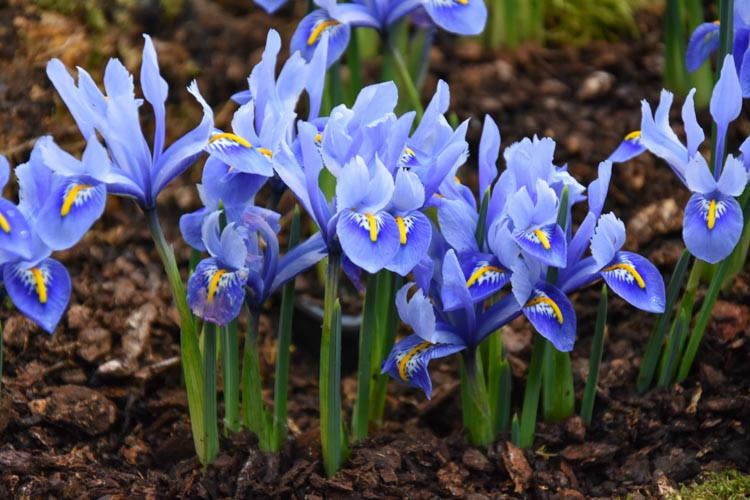
Dwarf Iris (Iris reticulata)
Blooms very early spring · Moderate, can fade after a few years · Left alone by squirrels
These tiny irises open right on the heels of the crocus, in the kind of deep violet-blue and gold that stops you on the front path. They're only four to six inches tall, so the trick is planting them somewhere you'll actually be up close: along a walkway, beside the front step, at the edge of a bed you pass every day. They're not the most reliable repeat performer. Some gardens get years out of them, others watch them dwindle into grassy leaves, but they're inexpensive enough to earn their spot even as a two-or-three-year pleasure.
In the ground: 3 to 4 inches deep, 3 inches apart, and they insist on good drainage. They'll rot in a heavy, wet spot, so give them somewhere on the leaner, grittier side.
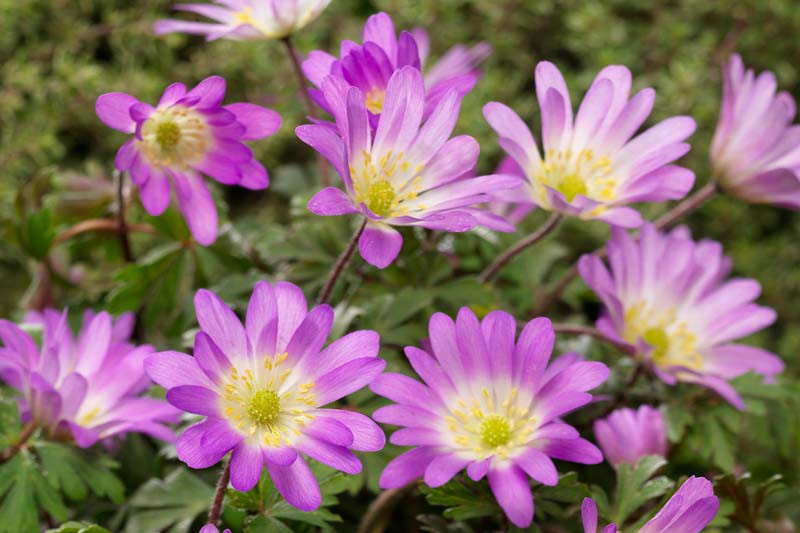
Grecian Windflower (Anemone blanda)
Blooms early spring · Naturalizes where it's happy · Left alone by squirrels
Low, daisy-like flowers in blue, white, or soft pink that open with the sun and fold up again at night. Planted in a group, they carpet the ground under shrubs and deciduous trees in a way that looks completely effortless. Fair warning: the tubers you buy look like dead little wood chips, with no obvious top or bottom. Soak them overnight before planting to wake them up, and don't fuss about which way up they go.
In the ground: 2 to 3 inches deep, 3 to 4 inches apart, in soil that holds a little moisture but still drains. Part shade to sun.
Grape Hyacinth (Muscari)
Blooms early to mid spring · Comes back readily and spreads · Left alone by squirrels
Those short, dense spikes of cobalt blue that look like tiny bunches of grapes. One thing that catches people off guard: the grassy foliage often pops up in fall and sits there all winter. That's normal, not a mistake, just leave it. Muscari spreads with real enthusiasm, so put it somewhere a growing colony is welcome. It's lovely threaded through and around tulips, and squirrels don't bother it.
In the ground: 3 to 4 inches deep, 3 inches apart.
Daffodils (Narcissus)
Blooms early to mid spring · Comes back reliably for years · The one squirrels never touch
If you plant nothing else off this list, plant these. Every part of a daffodil is toxic, which means squirrels and deer skip them entirely, so they're the anchor of any squirrel-proof planting. They also perennialize better than almost any other bulb, coming back and multiplying for years with no help. The only ones that sometimes lose steam are the fussiest doubles and split-cups, so if longevity is your priority, lean toward the classic trumpet and large-cup types. And because bloom times run all the way from March to May depending on variety, you can plant early, mid, and late daffodils and carry a single flower across most of spring.
In the ground: 6 inches deep (roughly two to three times the bulb) and 4 to 6 inches apart. After they finish, let the leaves yellow and die back on their own for about six weeks. That slightly scruffy stretch is the bulb recharging for next year, so resist the urge to cut it back early.
Hyacinth (Hyacinthus orientalis)
Blooms mid spring · Relaxes from formal to loose over time · Mostly left alone by squirrels
The big fragrant ones, the kind you can smell from across the yard. Worth setting expectations on these: that fat, dense, perfectly uniform spike you get the first year gradually loosens into a sparser, more informal one over the following seasons. Some people prefer the relaxed look. But if it's the tight florist shape you're after, treat them as a plant-fresh-every-few-years pleasure rather than a permanent fixture. Squirrels generally leave them be.
In the ground: 4 to 6 inches deep, 4 to 6 inches apart. (The bulbs make some people's skin itch, so gloves aren't a bad idea.)
Tulips (Tulipa)
Blooms mid to late spring · Depends entirely on the type · A squirrel target
The showstoppers, and the trickiest bulbs on this list, for two reasons. First, squirrels love them, the bulbs and sometimes the flowers too, so tulips need the most protection of anything here (see the planting rules below). Second, how long they last comes down to which kind you buy. The big showy hybrids bloom brilliantly year one, then taper off after two or three, which is why plenty of gardeners treat them as a fresh planting each fall. The smaller species tulips do the opposite: they return and slowly multiply for years. Both are legitimate choices, just plant them knowing which bargain you're striking. (I get further into the hybrid-versus-species question over in the spring blooming plants post.)
In the ground: 6 to 8 inches deep, 4 to 6 inches apart. Planting on the deeper end pulls double duty: it helps the hybrids return a little better, and it puts the bulb far enough down that casual squirrel digging turns up nothing.
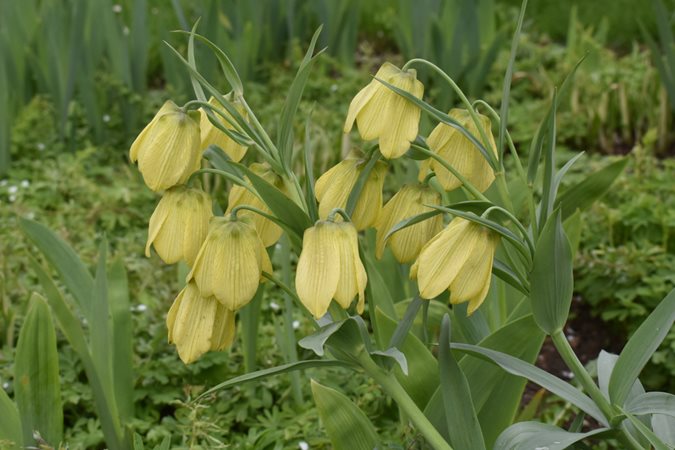
Fritillaria
Blooms mid to late spring · Naturalizes in moist soil · Squirrels actively avoid it
Two very different plants share this name. Snake's-head fritillary (Fritillaria meleagris) is a delicate nodding bell in an almost unbelievable checkered purple-and-white pattern, and it settles in happily where the soil stays a touch moist. Crown imperial (Fritillaria imperialis) is the theatrical cousin: a tall stem crowned with a ring of downward-facing orange or yellow bells. Its trick is its smell. It gives off a faintly skunky, foxy odour that rodents can't stand, which is exactly why gardeners tuck it in among their tulips as a living deterrent. If you add one squirrel-repelling flower this year, make it this one.
In the ground: snake's-head goes 3 to 4 inches deep and 3 inches apart in soil that holds moisture. Crown imperial is a big bulb, 5 to 8 inches deep and 8 to 12 inches apart, and it has a hollow crown on top that can collect water and rot. Plant it tipped slightly on its side, or set it on a small handful of grit, so water drains away instead of pooling.
Snowflake (Leucojum)
Blooms mid to late spring · Naturalizes and comes back · Left alone by squirrels
Elegant, easygoing, and criminally underused. Each stem carries several nodding white bells, and every petal is tipped with a tiny green dot, the sort of detail that looks like a botanical illustrator made it up. The common garden type (Leucojum aestivum) stands a surprising 18 to 24 inches tall, and as a relative of the daffodil it shares that same gift for being completely ignored by squirrels and deer. Give it a spot that stays a little moist and it will come back, year after year, with almost nothing asked of you.
In the ground: 3 to 4 inches deep, 4 inches apart, in soil that holds some moisture. Sun to part shade.
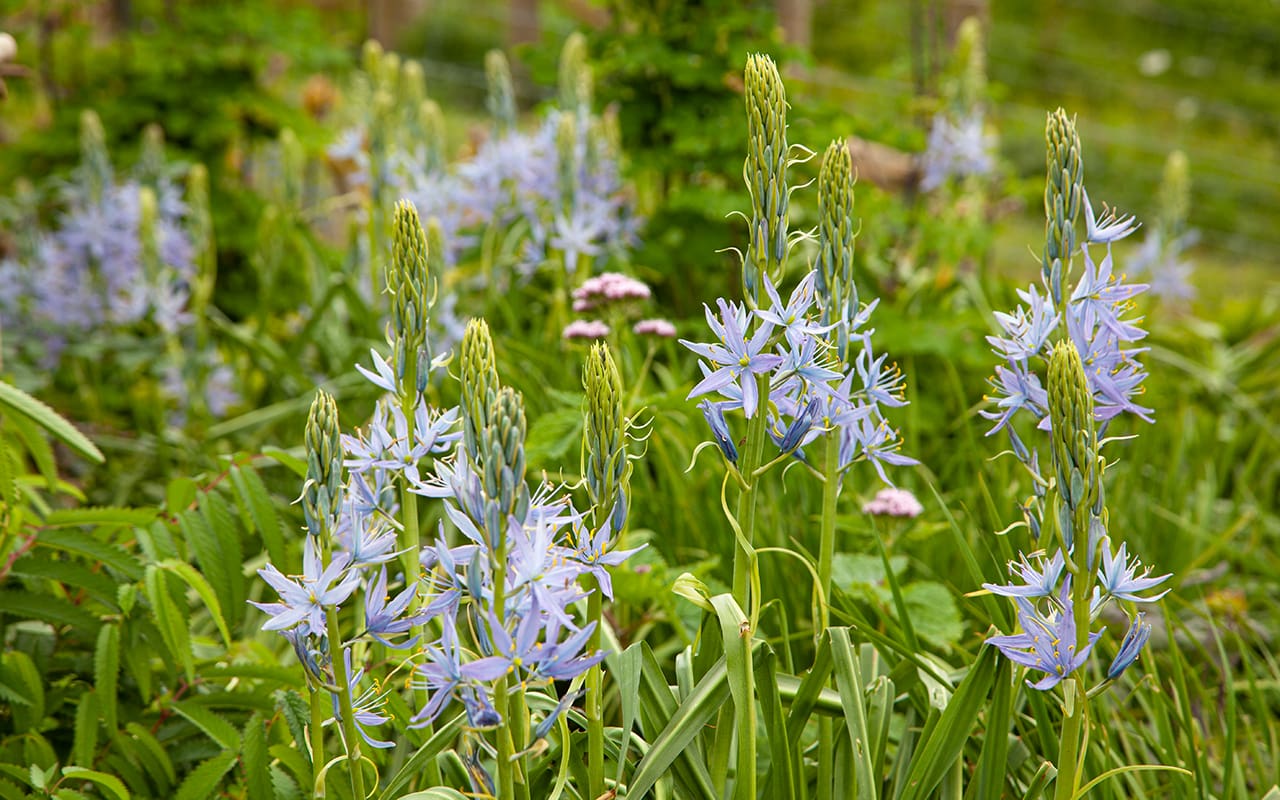
Camassia (Camas)
Blooms late spring · Comes back reliably · Deer and rodent resistant
One of the last bulbs to bloom and one of the loveliest: tall spires of star-shaped flowers in soft blue, purple, or white, rising two to three feet over the fading end of the tulip season. It's a North American wildflower (native to the continent, though not specifically to Ontario), and it's genuinely dependable, bulking up and returning a little stronger each year. Unusually for a bulb, it doesn't mind soil that stays damp, so that low, moisture-holding corner where other bulbs would rot is precisely where camassia is happiest.
In the ground: 4 to 6 inches deep, 4 to 6 inches apart, in soil that holds moisture. Full sun to part shade.
Ornamental Allium
Blooms late spring into early summer · Comes back · Nothing eats it
The finish line of the bulb season, and the bridge into summer. The classic forms are those perfectly round purple globes floating on tall bare stems, almost architectural in a border. Because they belong to the onion family, essentially nothing browses them: squirrels, rabbits, and deer all walk on by, which makes alliums one of the most foolproof bulbs you can plant. The one quirk to plan for is that the foliage yellows and flops just as the flowers open, so set them behind or among perennials that will grow up and screen the untidy base.
In the ground: depth depends on size. The big varieties like 'Globemaster' or giant allium go 6 to 8 inches deep and 8 to 12 inches apart; smaller kinds like drumstick allium sit 3 to 4 inches deep and 4 inches apart. The rule of thumb, three times the bulb's height, works across the whole genus.
A Few Rules That Apply to All of Them
Depth: when in doubt, plant at about three times the bulb's height, pointy end up. A little too deep is safer than a little too shallow. The exceptions are noted above (anemone tubers go in any which way, and crown imperial prefers to lie on its side).
Squirrel-proofing: three things genuinely help with the vulnerable ones, crocus and tulips especially. First, interplant the squirrel-proof bulbs, daffodils, alliums, and fritillaria, right in among them; the smell and taste put squirrels off the whole patch. Second, plant tulips on the deeper end so casual digging comes up empty. Third, lay a piece of chicken wire flat over the bed just under the mulch, or drop a little sharp grit into each hole, to make digging unpleasant. One thing to skip: blood meal, which can actually attract diggers rather than repel them.
Plant in clusters, not rows: bulbs look natural and generous in loose groups of odd numbers, and stiff and sparse in a straight line. Aim for drifts.
Then leave them be: water once after planting to settle them in, and that's the last thing they need from you until spring.
Where to Get Them
Locally, Northland Nursery here in Hamilton carries a good selection through the fall. If you'd rather order online, Breck's Canada ships fall bulbs across the country and, handily, times your shipment to arrive right when it's time to plant, so you're not left storing them for weeks. Either way, buy on the early side: the best varieties sell out well before the ground freezes.
One Afternoon Now, Months of Payoff Later
That's the real appeal of bulbs. The work is small, it's finite, and it happens at a time of year when there isn't much else to do in the garden. Then spring arrives and does the rest on its own.
If you'd like a bloom sequence built around your actual yard, your light, your soil, and your particular squirrel situation, that's exactly what a consult is for. Book a consult and we'll put together a plan that fits your space.
And if you're after more than bulbs, the shrubs, natives, and perennials that carry the early-spring garden, here's the companion post on spring blooming plants for Hamilton gardens.