

My mother has a collection of holiday cacti in her front window. Not little four-inch grocery-store ones — full, arching, decades-from-now plants that stop people in their tracks on the street, especially when they're covered in blooms. And the question she gets, almost word for word, is always some version of: what's your secret?
The honest answer is that there isn't one. There's just a misunderstanding baked right into the plant's name — yes, the one you call a Christmas cactus — and once you clear it up, this becomes one of the most forgiving, longest-lived plants you can keep.
So if you've ever had one shrivel, drop every bud the week before it was supposed to flower, or slowly turn to mush from the bottom up, this is information, not a verdict. You weren't bad with it. You were almost certainly handed the wrong instructions. Let's fix that — starting with figuring out what you've actually got on your windowsill.
Thanksgiving vs. Christmas vs. Easter Cactus: How to Tell Them Apart
Here's the first surprise: the plant most people own and call a "Christmas cactus" is usually a Thanksgiving cactus. They get sold under the Christmas name constantly, so this is incredibly common — and it's not a problem, it's just a case of mistaken identity. There are three plants that get lumped together under "holiday cactus," and you can tell them apart in about five seconds once you know where to look.
The trick is the edges of the flat green segments (those leaf-like pads are actually stems), plus when the plant blooms.
Here's the whole thing at a glance:
| Holiday cactus | Segment edges | Bloom time | Pollen |
|---|---|---|---|
| Thanksgiving (S. truncata) | Sharp, pointed, claw-like | Late November | Yellow |
| True Christmas (S. × buckleyi) | Rounded, scalloped | December–January | Pink |
| Easter (Rhipsalidopsis) | Rounded with small bristle tips | Spring | — |
And here's each one in a little more detail.
Thanksgiving Cactus — Schlumbergera truncata
This is the one you most likely have. The segment edges have sharp, pointed, claw-like hooks — which is exactly why it's also called crab cactus. It tends to bloom earliest, around late November, and its pollen reads yellow.
A quick note for those of us in Canada: the name throws people off here. Our Thanksgiving is in October, but this plant doesn't flower until a month or so later. The "Thanksgiving" in the name comes from the American holiday in late November — which is right when these tend to bloom. So if yours buds up well after our long weekend, it isn't behind schedule. It's just named on a different calendar than the one we use.
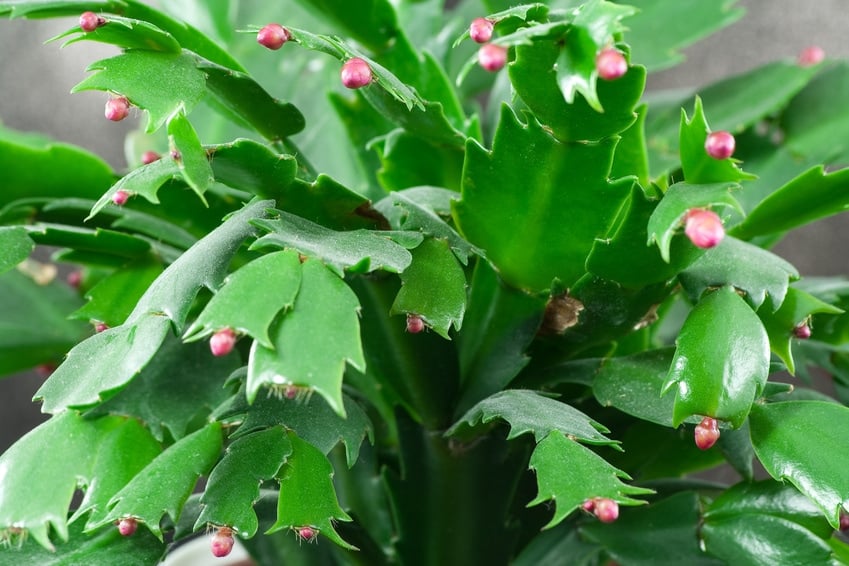
True Christmas Cactus — Schlumbergera × buckleyi
Less common in stores, more common as a passed-down plant from a grandparent or a plant-swap. The segment edges are rounded and scalloped — soft little waves instead of points. It blooms a bit later, December into January, the flowers hang more, and the pollen leans pink.
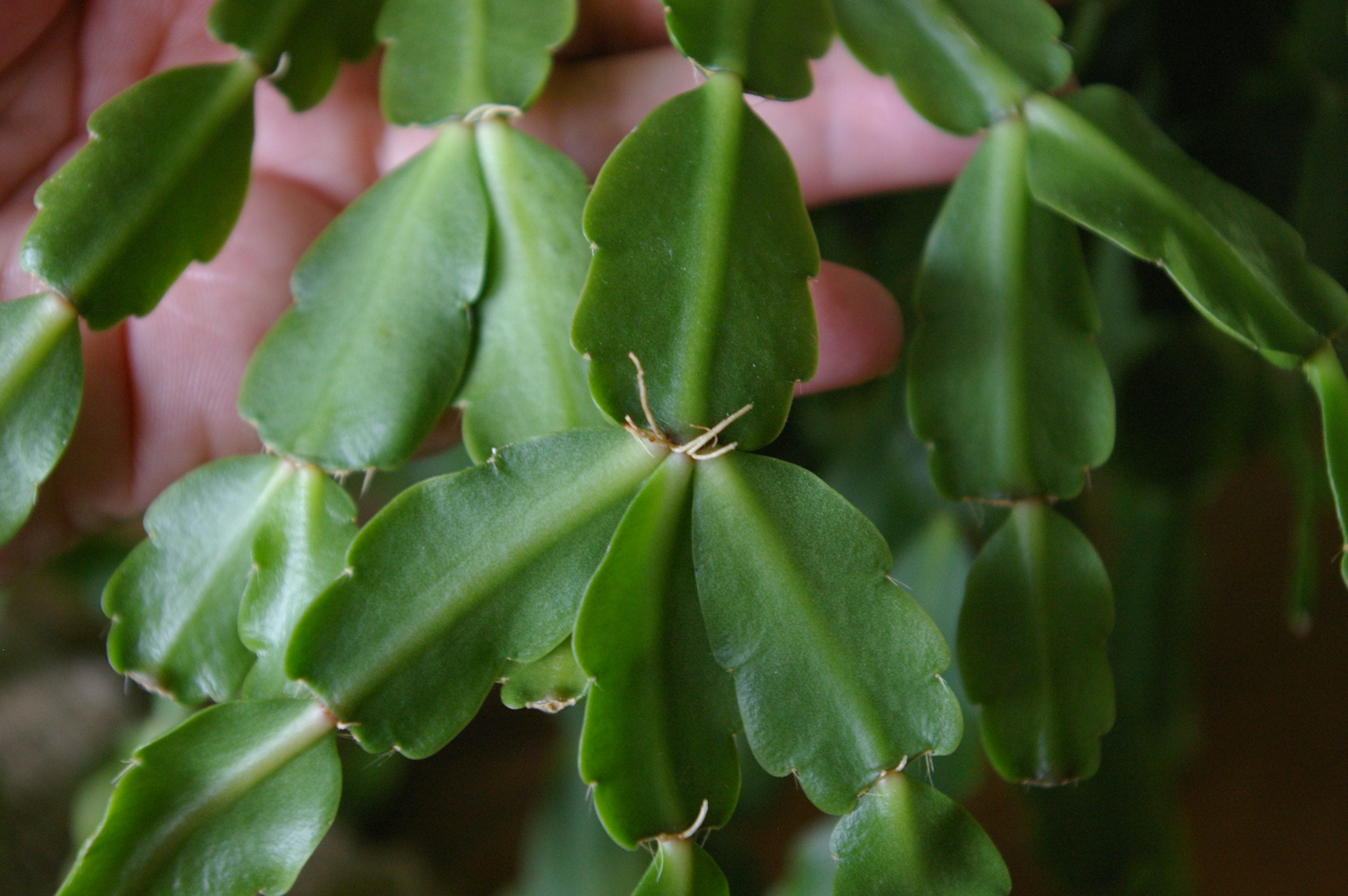
Easter Cactus — Rhipsalidopsis gaertneri
The odd one out. It's technically a different genus now (it's been reclassified away from Schlumbergera), but it rides along in the same conversation. Its segments are rounded with small bristles at the tips, and it blooms in spring with flowers that look more like symmetrical, many-pointed stars.

If you want to check yours right now: look at one segment edge. Pointed and grabby? Thanksgiving. Soft and scalloped? Christmas. Rounded with little whiskers, and it flowers in spring? Easter. No measuring required.
Knowing which one you have is satisfying, but here's the part that actually changes how you care for it — and it's the same for all three.
It's a Cactus, Just Not That Kind
When most of us hear "cactus," we picture a desert: blazing sun, sand, a plant you water roughly never. So that's how holiday cacti get treated — gritty soil, a sunny baking windowsill, weeks of drought. And that's where almost every sad, struggling one we see comes from.
These aren't desert plants. They're jungle epiphytes. In the wild they grow in the coastal mountains of Brazil, wedged into the crooks of trees and the shaded faces of rocks, rooting into pockets of leaf litter. Humid, dappled shade, never bone dry for long, never blasted by full sun.
If "epiphyte" is a new word, you've almost certainly met a few already. Orchids are epiphytes — that's exactly why a grocery-store moth orchid comes potted in chunky bark instead of soil. So are air plants, the staghorn ferns people mount on driftwood, and most bromeliads. They all run on the same logic: roots that want air as much as moisture, and a real dislike of sitting wet. Your holiday cactus is in that same club, even if it doesn't look the part — and that's your first clue about how to pot it.
That single fact is the why underneath everything below. Once you stop caring for it like a saguaro and start caring for it like the shade-loving forest plant it actually is, the rest is mostly common sense.
General Care
Potting
Because the desert picture is so strong, a lot of people reach for cactus or succulent soil — the gritty, sandy stuff. For these plants, that drains too fast and holds too little. What they want is a mix that breathes and holds some moisture: chunky and airy, but not desert-dry.
Our house blend is built for exactly this — two textures of coco coir for structure and water-holding, perlite for air pockets, and worm castings for gentle nutrition. (It's peat-free, which is the standard for everything we pot here.) If you're mixing your own, you're aiming for something an epiphyte would recognize: open, organic, quick to drain but never sandy.
One thing that surprises people: holiday cacti actually bloom better when they're a little snug in their pot. So if yours is flowering and healthy, you don't need to size up. This is the place to remember that repotting doesn't always mean a bigger pot — often the move is just refreshing the soil in the same one, so the plant gets new structure and nutrients without losing the cozy root space it likes. And if you do decide to move it and second-guess yourself, that's fine too. Plants can be transplanted. Nothing here is permanent.
Watering
This is where the desert instinct does the most damage, in both directions. People either leave it bone dry for a month because "it's a cactus," or they keep it constantly wet and it rots from the base.
The plant itself will tell you what it needs — you just have to reset your expectations. Stick a finger into the soil to about your first knuckle. Dry at that depth? Time to water. Still damp? Give it a few more days and check again. Through active growth, you're keeping it lightly, evenly moist — damp-ish, not soggy and not parched. After it finishes blooming it takes a short rest, and you can ease back a bit then.
Notice there's no schedule here. How fast your plant dries out depends on its light, the warmth of the room, the size of the pot, and the time of year — so a calendar will always lie to you, while a finger never does.
Fertilizing
Worth saying clearly, because it gets muddled everywhere: fertilizer isn't food. Your plant makes its own food out of light. Fertilizer is more like a multivitamin — a helpful supplement when the plant is actively growing, not the thing keeping it alive. (If you want the full version of why that distinction matters, we wrote a whole post on it: Fertilizer Isn't Plant Food.)
For holiday cacti, gentle is the whole game. Something like Kelpy — the cold-processed liquid kelp we carry at the refill station — diluted and used through the growing months does nicely. Then ease off as buds start forming and through the bloom, when the plant's putting its energy into flowering rather than new growth. Most of the harm we see here is at the extremes: either nothing at all for years, or something far too strong. Gentle and occasional beats heavy and frequent every time.
Getting It to Bloom: Seasonal Notes for Hamilton
"Why won't it flower?" is the question right behind "what's your secret?" — and the answer is genuinely good news if you live here.
Holiday cacti set their buds in response to two cues: longer nights and cooler temperatures. They need a good stretch of real, uninterrupted darkness each night — roughly thirteen hours or more — along with a dip into cooler evenings to get the signal that it's time to bloom.
Here's the local good news: a Hamilton fall hands you both for free. Sitting where we do, our daylight drops off quickly through October — by the back half of the month we're already past thirteen hours of darkness and still climbing toward the solstice. At the same time, evenings near the windows cool right down — and if you're in one of Hamilton's older homes, the single-pane, slightly drafty windows you usually grumble about turn into a genuine asset here, handing your plant the cool nights it wants before the furnace fully takes over. Your plant reads all of that as time to bloom. It's also why a Thanksgiving cactus flowers well after our October long weekend rather than on it — it's waiting on Hamilton's shortening days, not the calendar on the wall. For most of us here, the season does the work, and your main job is to stay out of its way.
Which also explains the most common reason one won't bloom: something is interrupting that dark stretch or keeping it too warm. A lamp it sits under in the evening, a TV glow, a bright hallway light, a spot right over a heat register — any of those can quietly tell the plant it's still summer. If yours is stubborn, the fix is often just moving it to a cooler room that goes properly dark at night for a few weeks in fall, and then leaving it be.
That "leaving it be" part matters more than it sounds, which brings us to the thing everyone panics about.
What's Normal, and What's Worth a Closer Look
A plant dropping growth or changing shape isn't misbehaving — it's responding to its conditions. Learning to read the difference between a normal response and a real problem is most of what confidence with this plant actually is.
Normal, not a problem:
- A bit of wrinkling or softening in the segments right before you water — that's just thirst, and it firms back up after a drink.
- An older segment dropping here and there as the plant grows.
- A reddish or purplish tinge to the segments in a bright spot — that's a light response, more cosmetic than concerning. Move it somewhere gentler if you don't love the look.
Worth a closer look:
- Segments going mushy, dark, or translucent, especially down at the base — that's usually a watering-and-soil issue rather than a thirst one, and it's the cue to check whether the roots are sitting wet.
- Widespread shrivelling that doesn't bounce back after watering.
- White, cottony spots tucked into the joints between segments — mealybugs like to hide there.
And then there's bud drop, the heartbreaker: a plant covered in buds that suddenly drops them all. It feels like failure, but it's almost always the plant reacting to a sudden change — getting moved, a swing in temperature, a draft, or letting it dry out hard while it was budding. The takeaway is freeing, actually: once your plant sets buds, pick its spot and leave it there. Resist the urge to rotate it onto the table for company. It's not fragile. It just doesn't like surprises mid-bloom.
When You Want a Second Set of Eyes
If yours came to you already struggling — mushy, dropping, or just sulking and you can't tell why — that's exactly what our Doctor's Appointments are for. Bring it by the shop on Sherman Ave and we'll do an intake, then you'll leave with a read on what's actually going on and where to go from here. No judgment about how it got there.
Because here's the thing that makes all of this worth getting right: a well-kept holiday cactus isn't a seasonal throwaway. These plants live for decades. The big ones in our shop will outlast the shelves they're sitting on, and plenty of the ones people bring in were started by a grandmother forty years ago. Get the care right once — forest plant, not desert plant — and you're not keeping a plant alive through the holidays. You're looking after something you can hand down.